A renewed commitment to Canvastera
It has taken us longer than we hoped to get here. Over the past two months, we have brought our focus back to Canvastera, with a long-term commitment to its future. Canvastera is now out of beta, with stronger foundations for what comes next.
The way we create and learn is changing. Our approach needs to evolve too, while keeping the reason we started: giving people a place to explore ideas and express them through multimedia posters.
You may have noticed small changes to Canvastera’s design over the past month. Those changes have led to a new website design, built to make it easier to create posters, find your work and contribute to the community.
Now we are ready to share what has changed, what we are building, and where we would like to go.
Groups that fit the way you work
Our new group management system is ready. It gives you a flexible way to organize members, communities and paid seats around your school, classroom or creative organization.
One school, or several separate spaces
You can use one group for an entire school, with communities for classrooms, subjects or projects. Communities are optional: a group can also bring people together without dividing their work into smaller spaces.
If your organization needs more separation, create a group for each school, classroom or workshop. Each group can have its own members and project communities. For example, a school network could keep each school in a separate group, while a teacher could use one group for a class and communities for its term projects.
Choose the community type that fits your project:
- Private communities are for invited members. Group owners and administrators can also see them.
- Open communities let anyone in the group see, open and join them. People outside the group cannot access them.
- Public communities let you share projects online. Group members can join directly, and signed-in users outside the group can view public posters through a shared link.
Who does what in a group
- Owner manages the group and the subscription that funds it.
- Administrators help manage members, communities and editing access across the group.
- Mentors lead their own communities and invite members to take part in their projects.
- Members work on posters and take part in the communities they join. In a school group, learners have the Student role. Students’ work is always visible to mentors within the group. Students do not have a private workspace.
Owners and administrators can invite people across the group. Mentors can invite new people, or existing group members, through the communities they manage. This helps teachers bring people into their own projects while administrators look after the wider group.
One subscription can support several groups
One Group subscription can fund seats in several groups owned by the same owner. A member who belongs to more than one of those groups shares one licence across them, as long as the groups are funded by that same subscription.
How seat priority works
Within each group, seats go to included members in priority order. You manage that order instead of assigning a permanent licence to each person. A member’s role does not decide their seat priority.
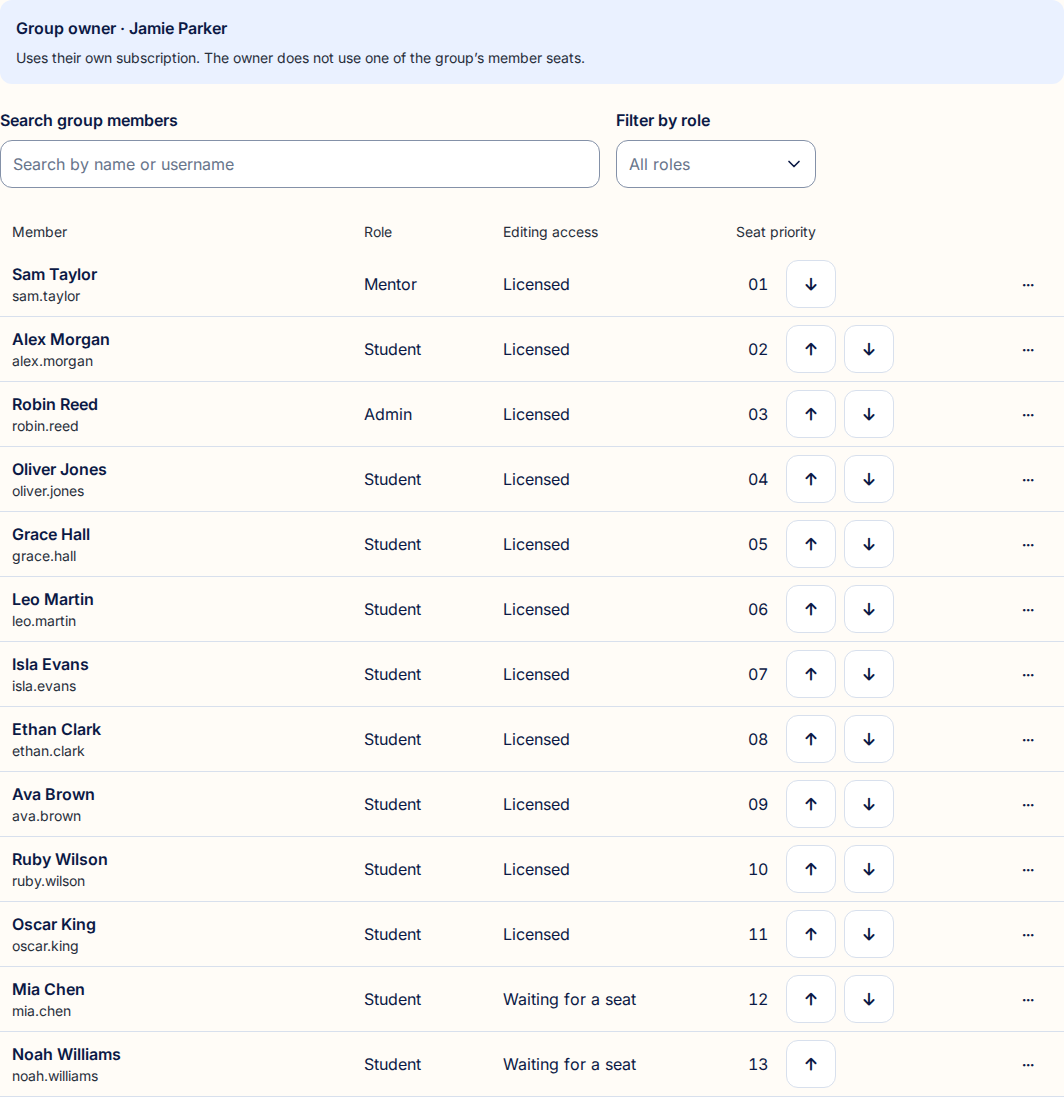
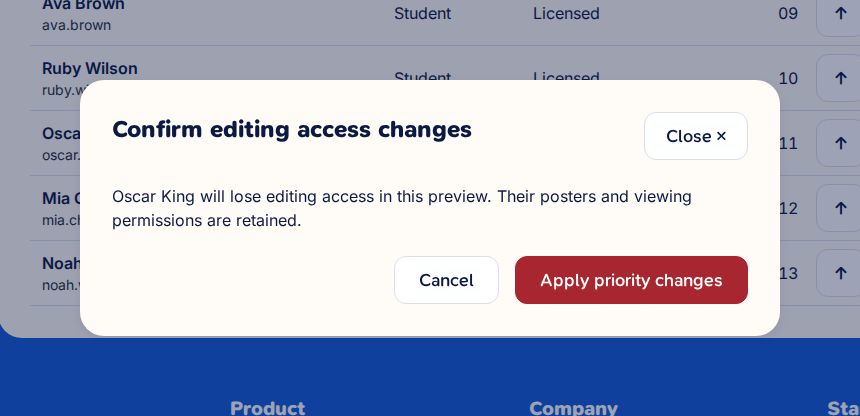
If a member is waiting for a licence, the group owner and administrators are notified by email.
A practical example: one group, several communities
Imagine an art club with one group for all its members. Create a private community for each workshop, such as illustration, photography and animation. Each mentor can organize their workshop’s projects and invite the members taking part.
Add an open community for club-wide creative challenges, so any group member can join. Use a public community as a showcase for public projects you want to share online.
Members can take part in several communities within the same group. If you later need separate spaces for different locations or organizations, create a group for each one, with its own workshop and project communities.
There is still more to polish. We want to hear how group administration works in real classrooms and organizations, from the people who manage subscriptions to the teachers who lead projects.
A new version of our editor
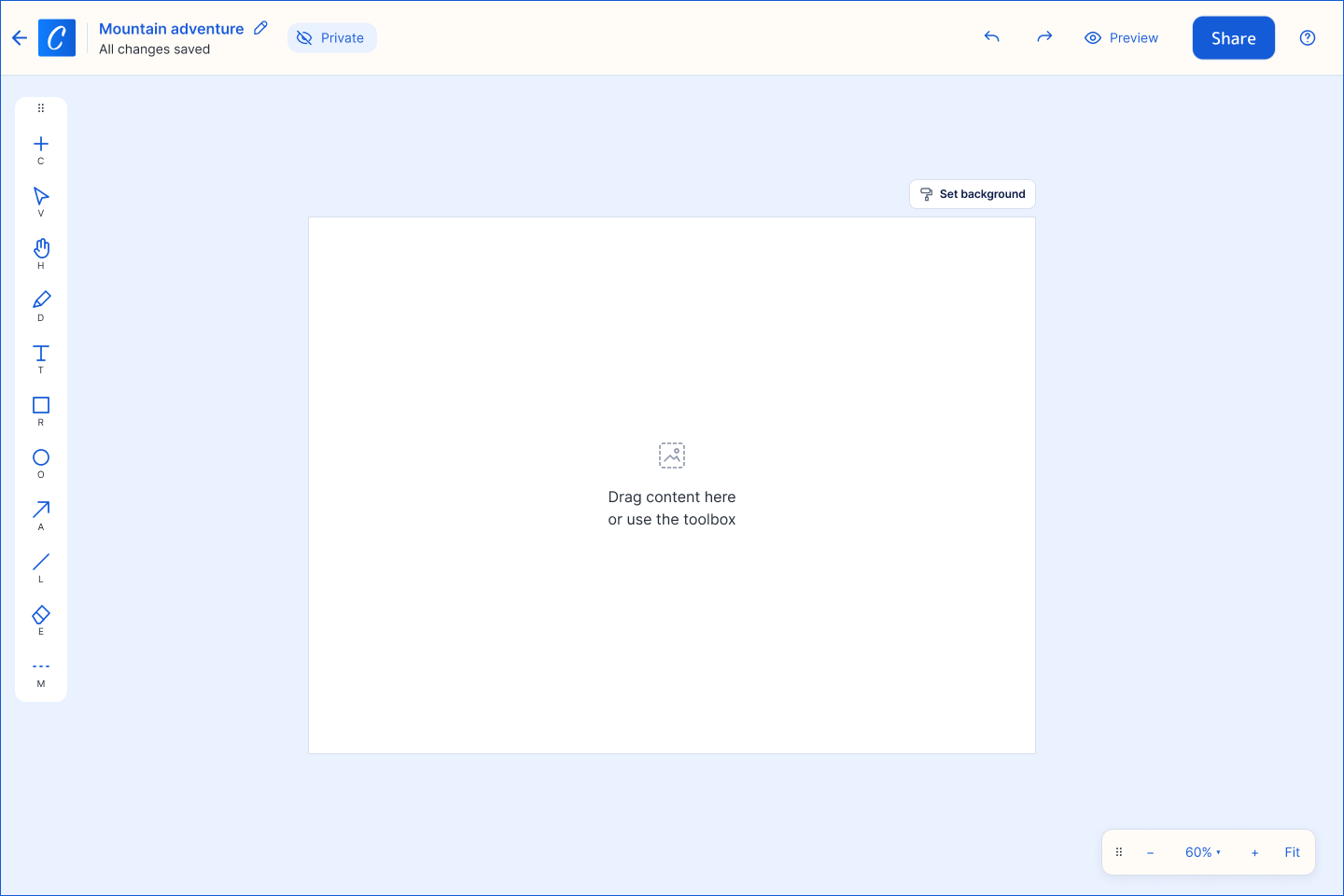
A new version of our editor is in development. We are rebuilding its foundations to support multiplayer editing, with the goal of letting people work on the same poster together.
We are also updating the editor’s design so you can find tools and add content faster. The aim is to give you more time for your ideas and less time searching through controls.
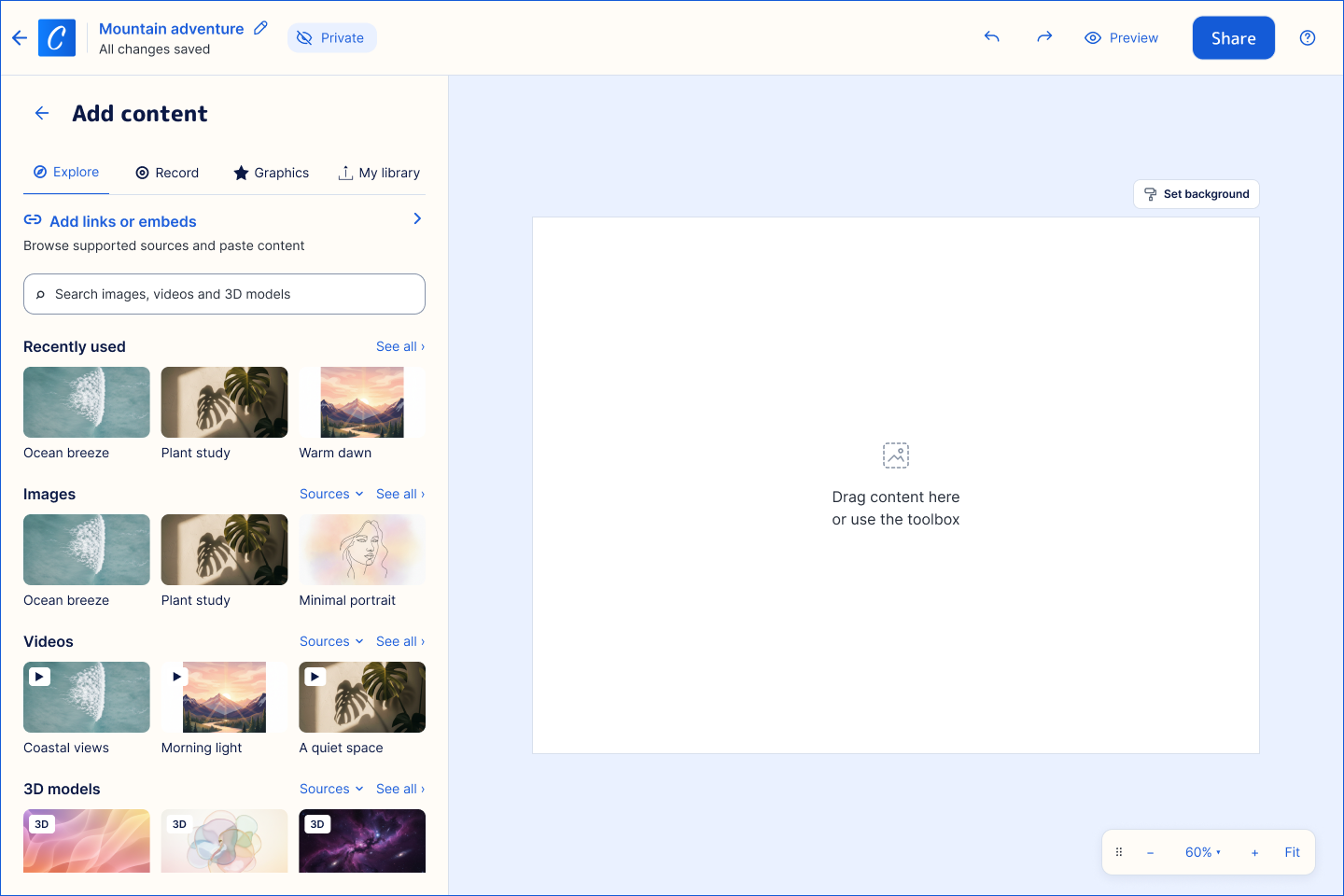
Add content with fewer interruptions
The new content tools are designed to make adding and arranging material more direct, so it is easier to build up a poster as your ideas develop.
Give the whole poster a consistent style
A new poster style feature will let you update the style of items across your poster together. Instead of changing each item separately, you will be able to adjust the overall look and keep related content consistent.
New, modern decorators will give you more ways to frame and present your content.
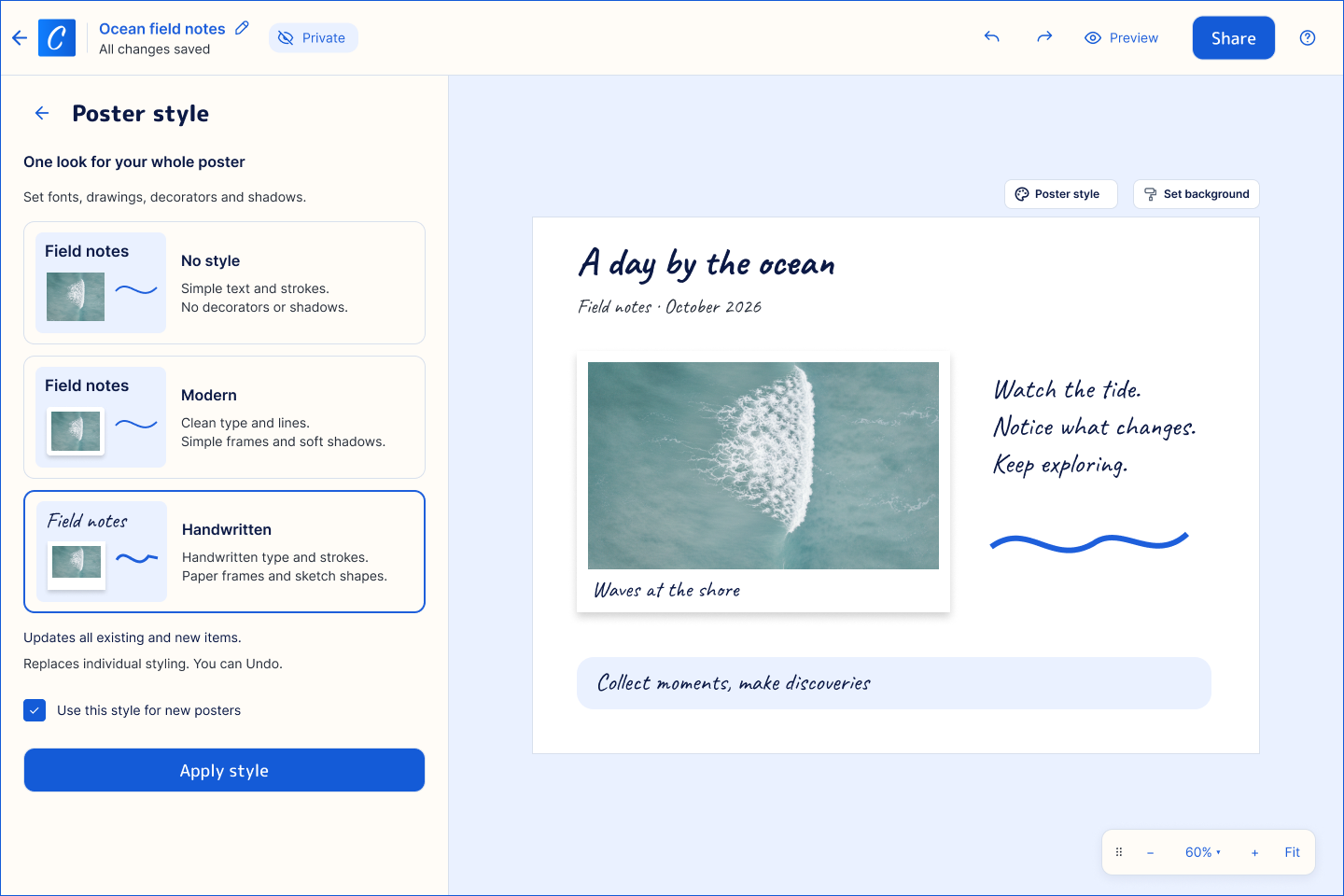
Our target is an initial release of this new version after Christmas 2026. This version is still in development. We will share more as it takes shape.
Canvastera 2.0: learning through creation
Alongside better group tools and the new version of our editor, we are exploring a longer-term direction: Canvastera 2.0, an AI-supported learning tool built around multimedia creation.
The idea is simple: students make their own explanations, receive feedback, and use it to improve their work. AI would help them ask questions and notice gaps, while students remain responsible for their ideas and decisions.
This Learning Loop is a proposal under exploration. We want to shape it with students, teachers and research organizations, and investigate where it could help in everyday learning.
Looking for European partners
We are looking for European schools, universities, research organizations and other partners to develop and evaluate this approach. We are also seeking an experienced consortium coordinator to explore EU grant opportunities, including Horizon Europe.
The partnership and funding are still being explored. No EU grant has been awarded.
Explore Canvastera 2.0 and partnership opportunitiesHelp shape what comes next
Tell us what works in your group, what slows you down, and what would make the editor more useful. Your experience will help guide our next steps.
Share your feedbackFinally, I want to thank the tens of thousands of people who have tried Canvastera over the past three years. Thank you to those who gave it a try and moved on, those who return every year, and those who bought a single licence to support us.
Martin Kluska
CEO, Canvastera